Thinking about Under Skin, 2019
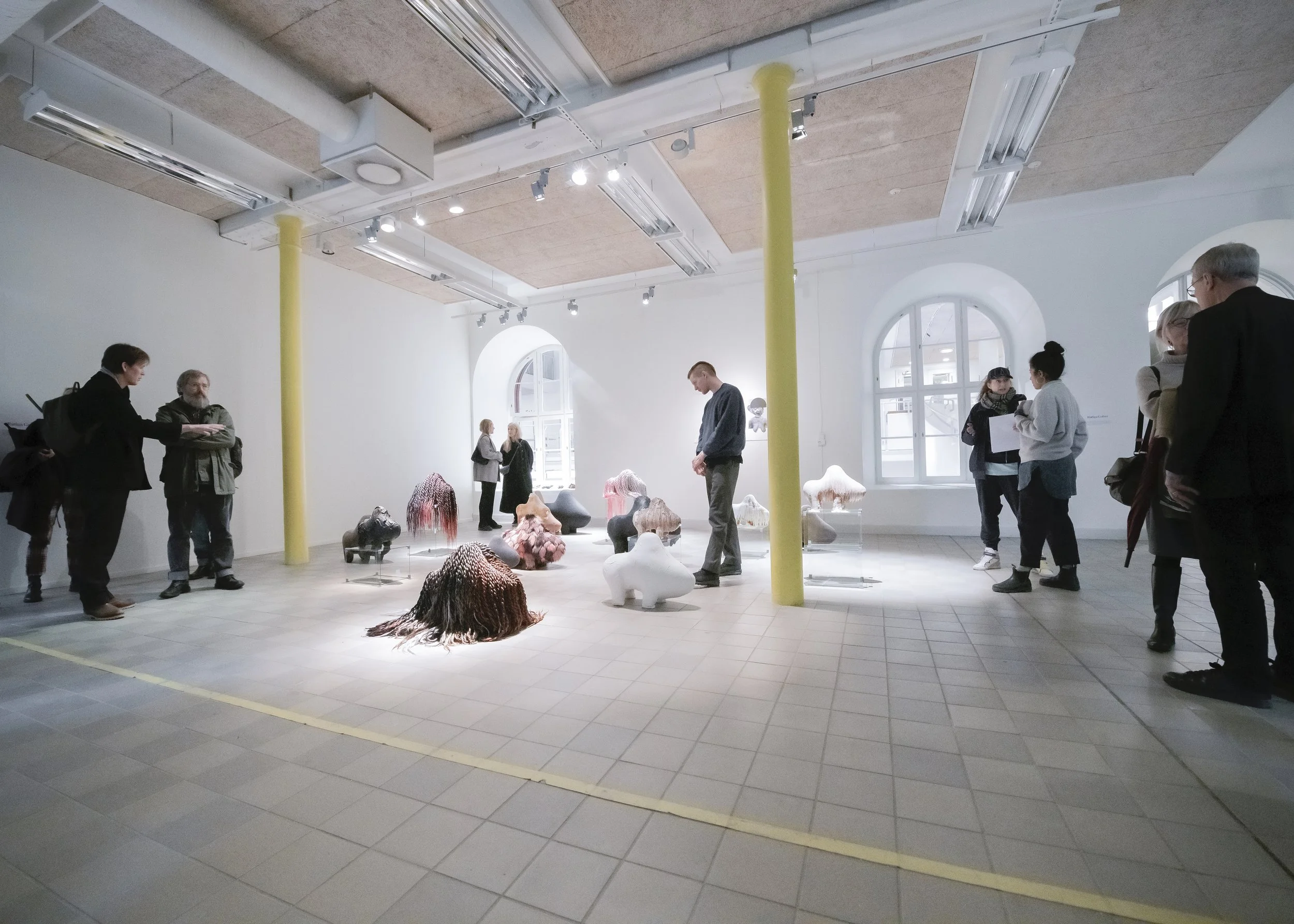
Under Skin came together at the Royal Institute of Art in Stockholm at the very end of my time there, with the careful support of curator Sara Rossling and Oliver Krug, Head of Communications. The checkered floor grid of the exhibition hall was not incidental; it became a visual and conceptual armature for the work, immediately evoking systems of order, strategy, and control.
The grid carried multiple references at once chess, of course, but also fashion, spectacle, and performance particularly Alexander McQueen’s It’s Only a Game (2005), where models begin with apparent autonomy only to become pawns in a choreographed logic they do not control. The slippage between agency and orchestration.
At the center of Under Skin were bull-shaped figures referencing Bamana boli power objects.
Together, they formed something closer to a system than a set of individual sculptures: a coalition, a multitude. In this sense, the work quietly conversed with Michael Hardt and Antonio Negri’s notion of collective force entities that gain power not through singular authority, but through aggregation, relation, and proximity. Standing together on the grid, the figures suggested both resistance and vulnerability: strength in numbers, but also exposure to the rules of the board.
The exhibition was framed by the concept of biopower, as articulated by Michel Foucault: the ways bodies and populations are regulated through systems that promise care, productivity, and optimization while quietly extracting compliance. At the same time, the work asked whether community and shared material intelligence might generate other modes of power other ways of living inside systems without being fully consumed by them.
This question extended into the satellite works. Tie-stained papers were folded, dried, and unraveled into fragile body forms, their surfaces marked by stains that read as scars. These bodies carried the residue of process as evidence: violence not as spectacle, but as inscription. Nearby, collages assembled from ethnographic archives and fashion imagery collapsed distinctions between science and style, classification and desire. Bodies were fragmented, recomposed, made unstable refusing easy narratives of value or origin.
PRESS RELEASE
UNDER SKIN
Marcia Kure
12–20 December 2019
Royal Institute of Art, Stockholm
Mixed-media installation by United States-based Nigerian artist Marcia Kure opens on 12 December at the Royal Institute of Art in Stockholm: Under Skin presents a new chapter in the artist’s ongoing exploration through an investigation into identities and power structures across geography and community
Currently guest professor at the Royal Institute of Art in Stockholm, the artist opens a dialogue around ‘bio-power’, a term coined by French philosopher Michel Foucault in the 1970s, describing authoritarian rule over individuals and entire populations through optimised productivity. Systems of power achieve social subjugation through raised standards of living, welfare and health conditions as well as technological advances in a problematic trade-off for increased collective control. As such the concept of bio-power frames the social sphere and human life as governed by mechanisms that adjust the self as well as the collective for the purpose of control.
Under Skin takes the premise of bio-power, yet poses the question: Can community, in our day, create ideas and practices of power and with them, develop affirmative modes of living and socio-political organization? In contemplating this question, Kure’s starting point is the bull-shaped boli figure – the form and idea of which are central to the exhibition. Produced by Bamana sculptors from West Africa and owned by secret power associations, these enigmatic objects become potent tools for the manipulation of elemental and cosmic powers. Moreover, the accretion of diverse ritual materials, deposited over time by the owners on its surface or skin, invariably signified its accumulation of power and energy.
Kure’s boli figures, made from hair extensions, candle wax, plaster and pigments invoke the form of Bamana power figures yet gesture towards elements of high fashion, mass consumption and entertainment. Thus, though the figures seem playful, massed together, they constitute a coalition of diverse energies – pointing towards Hardt and Negri’s concept of multitude, arrayed against the global, post-ideological and post-national empire – as they stand strong together, on the checkered floor of the Royal Institute’s exhibition hall.
In a nod to Alexander McQueen’s 2005 runway show It’s Only a Game, in which fashion models at first move around freely, showing off the latest from the designer’s haute couture, but eventually are turned into marionette-like pawns on a chessboard lit up on the luminescent floor – until the game reaches a disastrous checkmate – Kure aligns the boli figures in formation, as if ready for a power play with Empire’s immanent forces.
The artist further explores the body as a site of protest in the satellite works that connect to the central stage occupied by the power figures. Here she implicates science as a tool that in the hands of political authorities is deployed to regulate human bodies, control knowledge, and maintain systemic order. What the spectator sees is tie-stained paper, which when dried and unraveled become bodies whose skins show scars of their physical trauma. These marked bodies bear testimony to technologies of bodily violence upon which old and new political hegemony depend.
Under Skin furthermore includes two of Kure’s new collages. Using material from the archives of the Ethnographical Museum in Stockholm, the artist reassembles body parts, objects from ethnographic auction catalogues, and images from fashion magazines to create figures in which the politics and histories of empire and colonial subjection, art and beauty, fashion and prejudice collide – thus suspending ready assumptions about meaning, value and valence of contemporary bio-power.
Marcia Kure studied at the University of Nigeria and is also an alumni of the Skowhegan School of Painting and Sculpture. In addition to exhibitions in Nigeria, Germany, the Netherlands, England and the United States, her work has been exhibited at La Triennale, Paris (2013), International Biennial of Contemporary Art, Seville (2006) and Sharjah International Biennale (2005). Kure is currently a visiting professor at The Royal Institute of Art where she works with the school’s students on the course Pushing Boundaries: New Forms of Sculptures, which seeks to broaden the definition of sculpture.
Royal Institute of Art Stockholm is a leading art institution for higher education and research in Stockholm with a long artistic tradition since the 18th century. It offers both graduate- and postgraduate education in art, and postgraduate education in architecture. The school runs an active international programme with projects, lectures, exhibitions and publications.
Rutiga Golvet (The Checkered Floor) was initiated in 2017 as a meeting space for art theory, publication, exhibitions and seminars, for artists to attend to urgent issues and to develop artistic and educational projects. Rutiga Golvet is a workshop space for thought and discourse where curators, editors, critics and art scholars are invited to interact with the Royal Institute of Art’s educational programmes – capturing, highlighting and deepening artistic and philosophical issues that exist at the school, and putting them in relation to a larger world.
Under Skin, curated by Sara Rossling.
Feburary 6th 2026
Under Skin came together at the Royal Institute of Art in Stockholm at the very end of my time there, with the careful support of curator Sara Rossling and Oliver Krug, Head of Communications. The checkered floor grid of the exhibition hall was not incidental; it became a visual and conceptual armature for the work, immediately evoking systems of order, strategy, and control.
The grid carried multiple references at once chess, of course, but also fashion, spectacle, and performance particularly Alexander McQueen’s It’s Only a Game (2005), where models begin with apparent autonomy only to become pawns in a choreographed logic they do not control. The slippage between agency and orchestration.
At the center of Under Skin were bull-shaped figures referencing Bamana boli power objects.
Together, they formed something closer to a system than a set of individual sculptures: a coalition, a multitude. In this sense, the work quietly conversed with Michael Hardt and Antonio Negri’s notion of collective force entities that gain power not through singular authority, but through aggregation, relation, and proximity. Standing together on the grid, the figures suggested both resistance and vulnerability: strength in numbers, but also exposure to the rules of the board.
The exhibition was framed by the concept of bio-power, as articulated by Michel Foucault the ways bodies and populations are regulated through systems that promise care, productivity, and optimization while quietly extracting compliance. At the same time, the work asked whether community and shared material intelligence might generate other modes of power other ways of living inside systems without being fully consumed by them.
This question extended into the satellite works. Tie-stained papers were folded, dried, and unraveled into fragile body-forms, their surfaces marked by stains that read as scars. These bodies carried the residue of process as evidence: violence not as spectacle, but as inscription. Nearby, collages assembled from ethnographic archives and fashion imagery collapsed distinctions between science and style, classification and desire. Bodies were fragmented, recomposed, made unstable refusing easy narratives of value or origin.
What Dot saw on a Walk
What Dot saw on a Walk
Paul Klee:
A line is a dot that went for a walk
Question:
Where did the dot go?
What did the dot see? Who did the dot meet? How did the dot feel on the walk?
#studionotes
The Dot and the Line: A Romance in Lower Mathematics
Directed by Chuck Jones
Co-directed by Maurice Noble
Narrated by Robert Morley
Produced by Metro-Goldwyn-Mayer
Won the Academy Award for Animated Short Film (1965).
February 24th 2026
The story details a straight blue line who is hopelessly in love with a red dot. The dot, finding the line to be stiff, dull, and conventional, turns her affections toward a wild and unkempt squiggle. Taking advantage of the line's stiffness, the squiggle rubs it in that he is a lot more fun for the dot.
The depressed line's friends try to get him to settle down with a female line, but he refuses. He tries to dream of greatness (seeing himself as a daredevil, a leader in world affairs, a law enforcer, a vital element in the art world, and a sportsman) until he finally understands what the squiggle means and decides to be more unconventional. Willing to do whatever it takes to win the dot's affection, the line manages to bend himself and form angle after angle until he is nothing more than a mess of sides, bends, and angles. After he straightens himself out, he settles down and focuses more responsibly on this new ability, creating shapes so complex that he has to label his sides and angles in order to keep his place.
When competing again, the squiggle claims that the line still has nothing to show to the dot. The line proves his rival wrong and is able to show the dot what she is really worth to him. When she sees this, the dot is overwhelmed by the line's responsibility and unconventionality. She then faces the now nervous squiggle, whom she gives a chance to make his case to win her love.
The squiggle makes an effort to reclaim the dot's heart by trying to copy what the line did, but to no avail. No matter how hard he tries to re-shape himself, the squiggle still remains the same tangled, chaotic mess of lines and curves. He tries to tell the dot a joke, but she has realized the flatness of it, and he's forced to retreat. She realizes how much her relationship with the squiggle had been a mistake. What she thought was freedom and joy was nothing more than sloth, chaos, and anarchy.
Fed up, the dot tells the squiggle how she really feels about him; denouncing him as meaningless, undisciplined, unkempt, unaccountable, insignificant, indeterminant, inadvertent, out of shape, out of order, out of place, and out of luck. She leaves with the line, having accepted that he has much more to offer, and the punning moral is presented: "To the vector belong the spoils." https://en.wikipedia.org/wiki/The_Dot_and_the_Line
Paul Klee:
A line is a dot that went for a walk
Question:
Where did the dot go?
What did the dot see? Who did the dot meet? How did the dot feel on the walk?
#studionotes
The Dot and the Line: A Romance in Lower Mathematics
Directed by Chuck Jones
Co-directed by Maurice Noble
Narrated by Robert Morley
Produced by Metro-Goldwyn-Mayer
Won the Academy Award for Animated Short Film (1965).