Pigment, Extraction, and the Weight of Material
Pigment Extraction and the Weight of Material examines how color begins in soil, bark, seed, and mineral. Reflecting on extraction, labor, and trade, Marcia Kure considers pigment as network, not merely surface, where each mark carries the weight of geology, history, and power. Drawing emerges as inscription shaped by material origin and circulation.
When I began developing my proposal for the wall drawing installation at the Menil Drawing Institute in Houston, I returned to a question that continues to structure my practice: Where does a material begin?
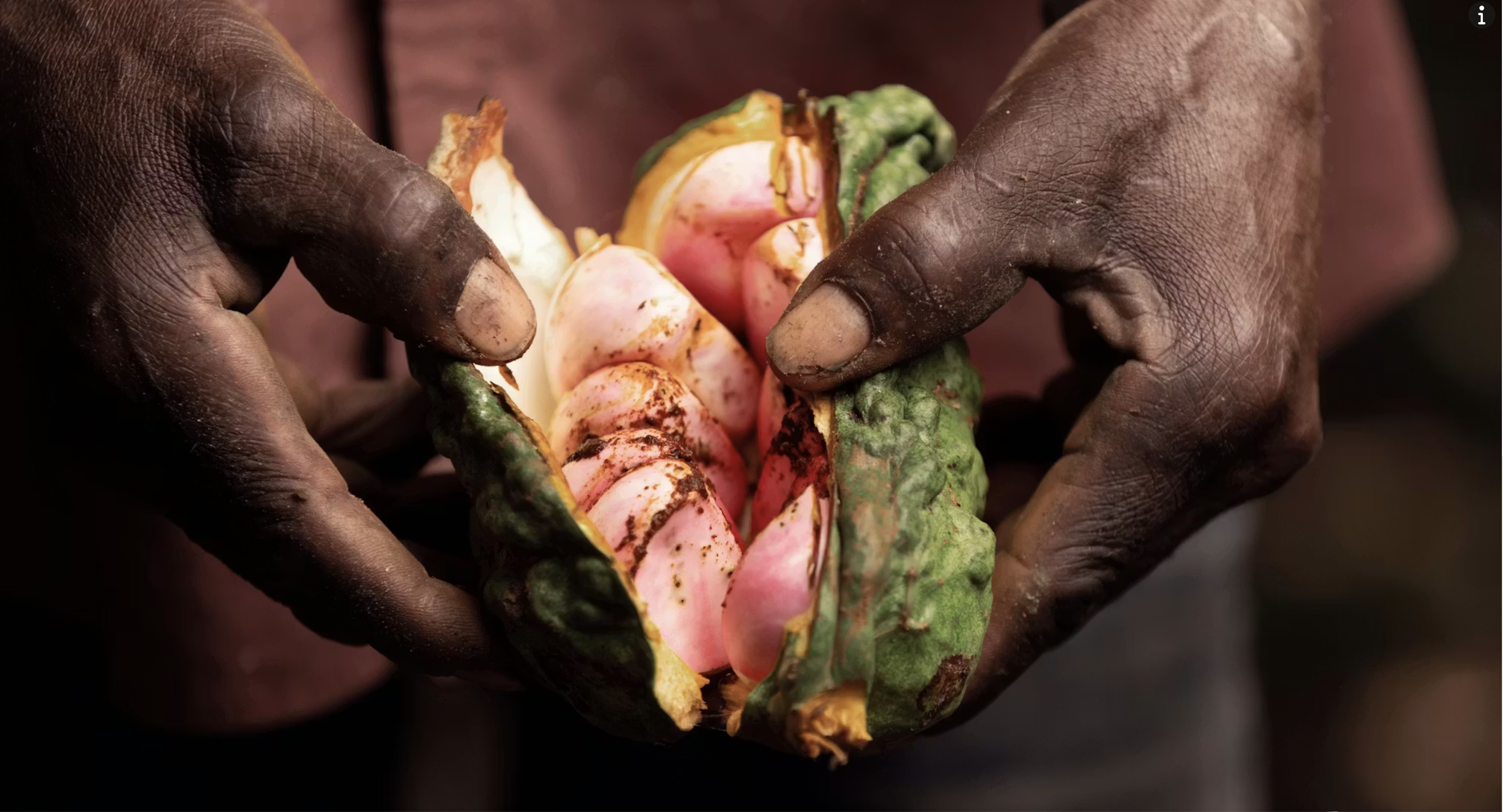
It does not begin in the studio or on the wall. It begins in soil, bark, seed, and mineral. It begins in cultivation and labor. It begins within systems of knowledge that precede artistic intention. To ask where a material begins is to ask about geology, agriculture, trade, and the movement of bodies across territory.
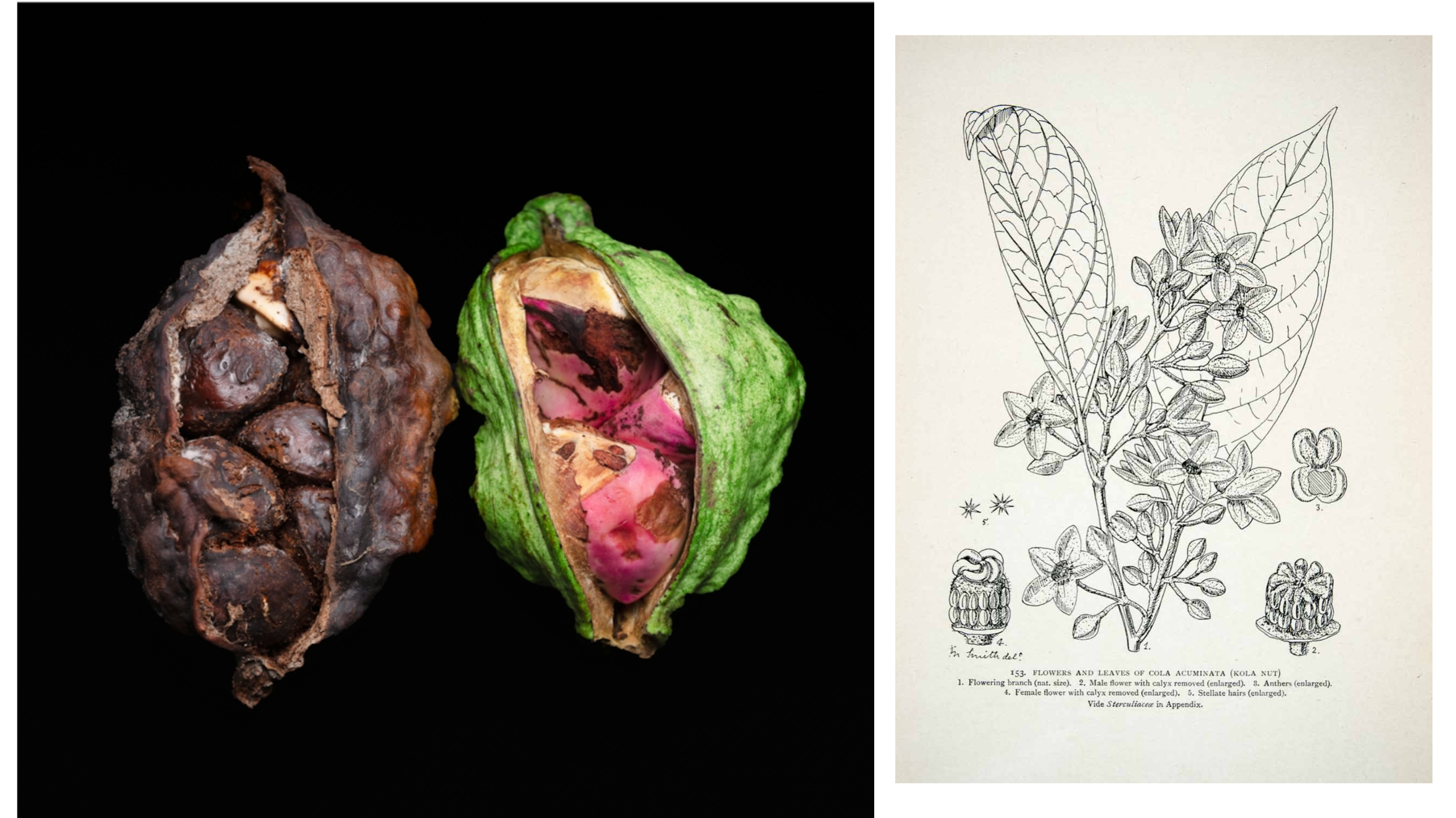
Right: A close-up view of two kola nut shells. The shell on the left shows natural post-harvest decay, while the shell on the right remains freshly harvested and intact. Despite the deterioration of the outer husk over time, the inner kola nut remains preserved once the shell is removed, underscoring kola nut durability. Image courtesy of Wellcome Collection. Photography by Yaw Afrim Gyebi, 2025.
Left: Botanical lithograph of Cola acuminata (kola nut plant), 1906, illustrated by Matilda Smith for Curtis’s Botanical Magazine. The composition presents the plant in scientific detail, with elongated leaves, delicate star-shaped flowers, and segmented pods shown both intact and opened to reveal the seeds within.
During my visiting professorship at the Royal Institute of Art in Stockholm in 2019, I extended my study of kola nut pigment and its extraction, a material I have worked with since my years at the University of Nigeria, Nsukka. At the same time, I began thinking more rigorously about naturally derived pigments in general: plants, earth, minerals, and the processes through which they are crushed, soaked, burned, fermented, and ground before binding to a surface. Each stage involves technical knowledge and intervention. Each stage situates pigment within systems of extraction and exchange.
© MARCIA KURE. This video clip captures a lecture by Malla Tallgren on pigments and their material life, presented on Monday, 9 September 2019, at the Royal Institute of Art in Stockholm. Challenging the idea that color is immaterial, Tallgren examines pigments as concrete particles derived from distinct material sources, each with its own shape, size, and chemical composition. Tallgren is a lecturer at the Academy of Fine Arts, University of the Arts Helsinki. The lecture formed part of Pigments from Nature, a course developed by Tallgren and held at Mejan for the first time in collaboration with Kristina Janni Ståhl.
While in Stockholm, I attended a lecture by Malla Tallgren, a specialist in painting materials and methods whose course on natural pigments traces the historical and technical dimensions of color production. The lecture was methodical and materially grounded. What remained with me was a structural insight: every pigment has a lineage. No color is neutral. Each carries the conditions of its making.
This awareness clarified the material and historical weight of working with indigo and kola nut. Indigo cultivation in the Americas relied on agricultural knowledge carried by enslaved West Africans, embedding diasporic expertise within plantation economies. What appears as a luminous blue is inseparable from forced migration, coerced labor, and transatlantic exchange. Kola nut, long central to West African ceremonies and trade networks, entered colonial commodity circuits and later industrial production, shifting from communal exchange to global consumption. Both materials exceed pigment. They bear the marks of displacement, circulation, and transformation.
To use indigo and kola nut in a drawing is not merely a chromatic decision. It situates the work within routes of travel, systems of value, and accumulated histories. Pigment becomes condensed geography, matter carried through hands, territories, and markets before arriving in the studio.
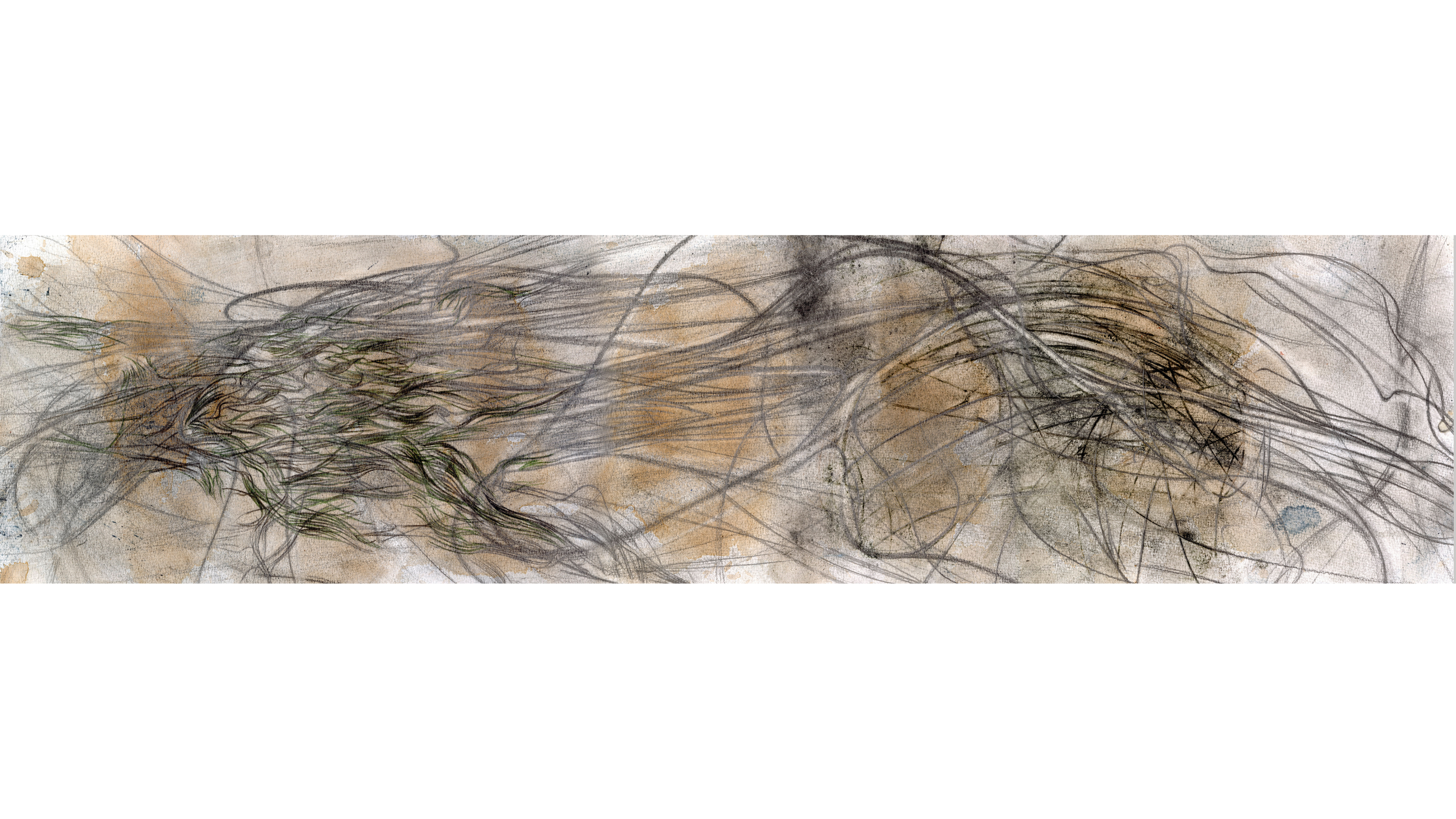
© MARCIA KURE: Sketch for Menil Wall Drawing Commission, 2021
In that installation, the line does not function as contour or boundary. It operates as linkage. It evokes trade routes, fiber optic cables, scars, and migration paths. The line collapses distance and disrupts sequence. It stages simultaneity rather than progression. The drawing becomes a mesh in which fragments intersect and overlap, carrying residues of past systems into present configurations.
The more I examined pigment extraction, the more I understood that materials themselves are networks. Extraction intervenes in land. Processing applies knowledge to matter. Trade circulates value. Use inscribes surface. Each mark therefore contains prior actions. It is never isolated from the systems that produced it.
The work proposes that drawing is a form of infrastructure: a field where matter, memory, and power converge and become legible.
This recognition altered how I approached the wall. A surface is not neutral. It can be scarred, gouged, and stained. It can register pressure and incision. Just as pigment holds histories of labor and trade, substrate holds histories of force. The wall becomes a field where material memory is made visible.
Thinking through merchant capital, in which bodies were bought and sold to generate profit, and surveillance capital, in which data is harvested and monetized, I began to see continuity in extraction logics. Soil is mined. Minerals are mined. Attention is mined. Data is mined. Technologies change, but the structural logic of accumulation persists. Exchange remains central to value production.
Pigment extraction therefore operates in this work not only as subject but as method. To draw with indigo and kola nut is to acknowledge that drawing participates in historical and contemporary circuits of exchange. To stain a wall with these substances is to foreground the entanglement of aesthetics and economy, of beauty and violence.
Material knowledge is inseparable from political knowledge. The way a pigment is sourced, processed, and circulated shapes the conditions under which it appears as art.
Since Stockholm, I have become more deliberate about the weight I place on materials. I do not ask them only to describe form. I ask them to carry memory and to register systems. Networks of Entanglement proposes that drawing is not a neutral act of mark making. It is participation in exchange. It is inscription within layered structures of power, labor, and value. Pigment, granular and seemingly quiet, is never neutral. It arrives already entangled.
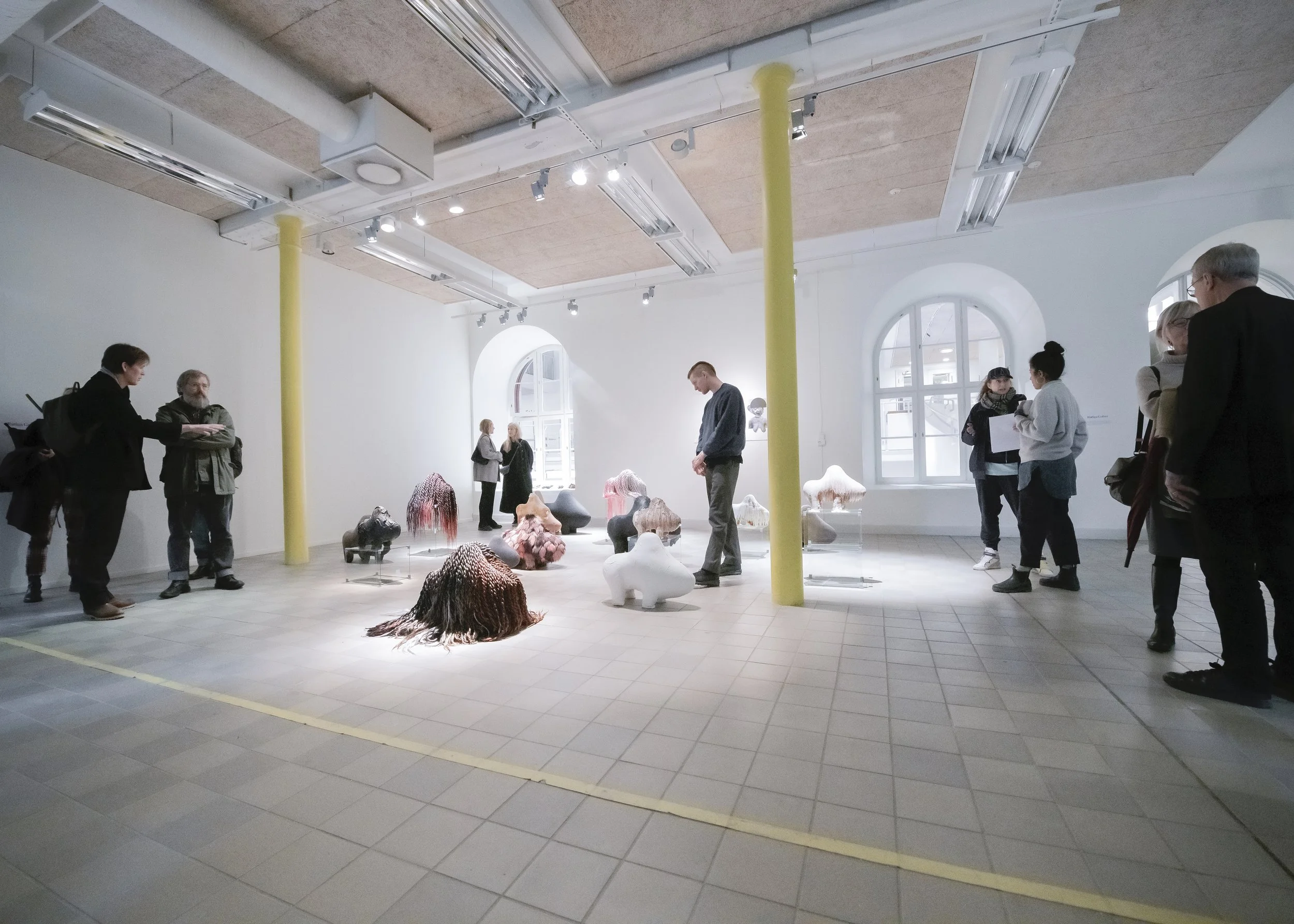
Thinking about Under Skin, 2019
Under Skin unfolded across the checkered floor of the Royal Institute of Art in Stockholm, where the grid became both stage and system, a field of lines mapping order, strategy, and control. Bull-shaped figures referencing Bamana boli objects gathered as a coalition within this architectural diagram, invoking biopower, collective force, and the slippage between agency and orchestration. Extending into scarred paper bodies and archival collages, the installation examined how power inscribes itself onto skin, space, and social form.
Under Skin came together at the Royal Institute of Art in Stockholm at the very end of my time there, with the careful support of curator Sara Rossling and Oliver Krug, Head of Communications. The checkered floor grid of the exhibition hall was not incidental; it became a visual and conceptual armature for the work, immediately evoking systems of order, strategy, and control.
The grid carried multiple references at once chess, of course, but also fashion, spectacle, and performance particularly Alexander McQueen’s It’s Only a Game (2005), where models begin with apparent autonomy only to become pawns in a choreographed logic they do not control. The slippage between agency and orchestration.
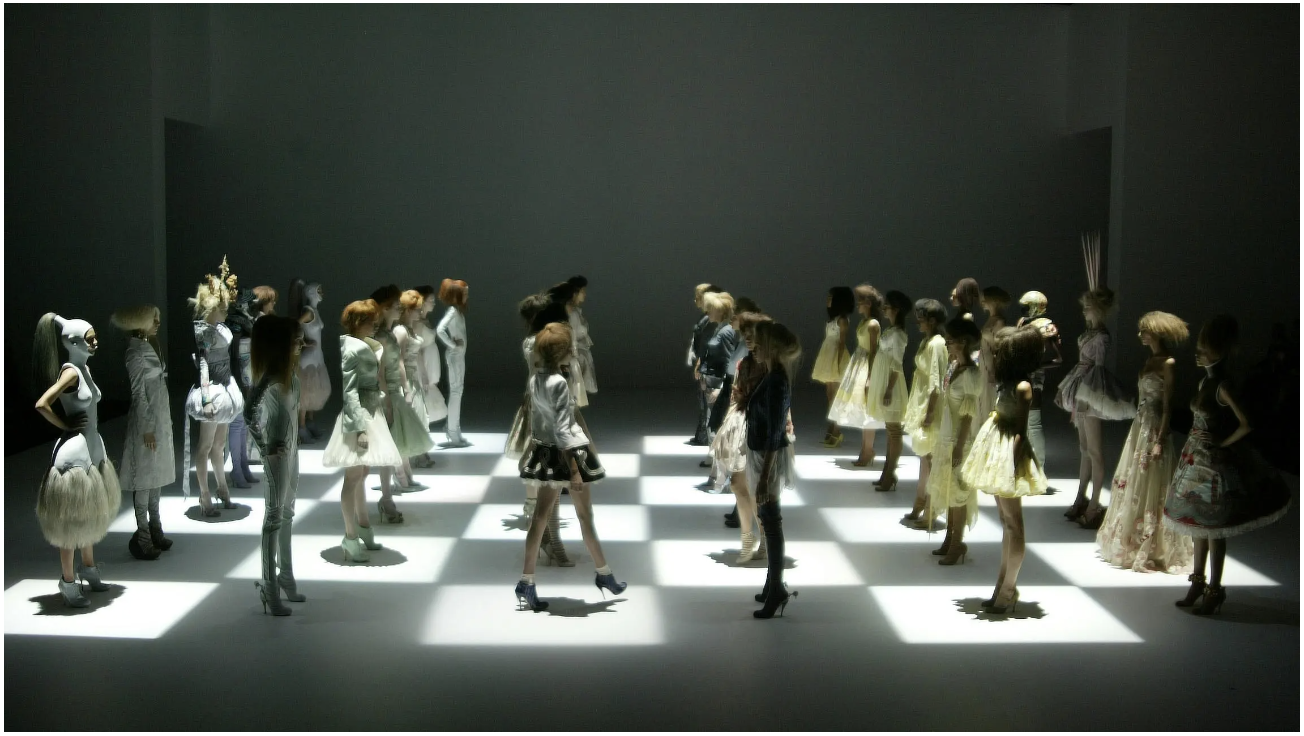
At the center of Under Skin were bull-shaped figures referencing Bamana boli power objects. Together, they formed something closer to a system than a set of individual sculptures: a coalition, a multitude. In this sense, the work quietly conversed with Michael Hardt and Antonio Negri’s notion of collective force entities that gain power not through singular authority, but through aggregation, relation, and proximity. Standing together on the grid, the figures suggested both resistance and vulnerability: strength in numbers, but also exposure to the rules of the board.
The exhibition was framed by the concept of biopower, as articulated by Michel Foucault: the ways bodies and populations are regulated through systems that promise care, productivity, and optimization while quietly extracting compliance. At the same time, the work asked whether community and shared material intelligence might generate other modes of power other ways of living inside systems without being fully consumed by them.
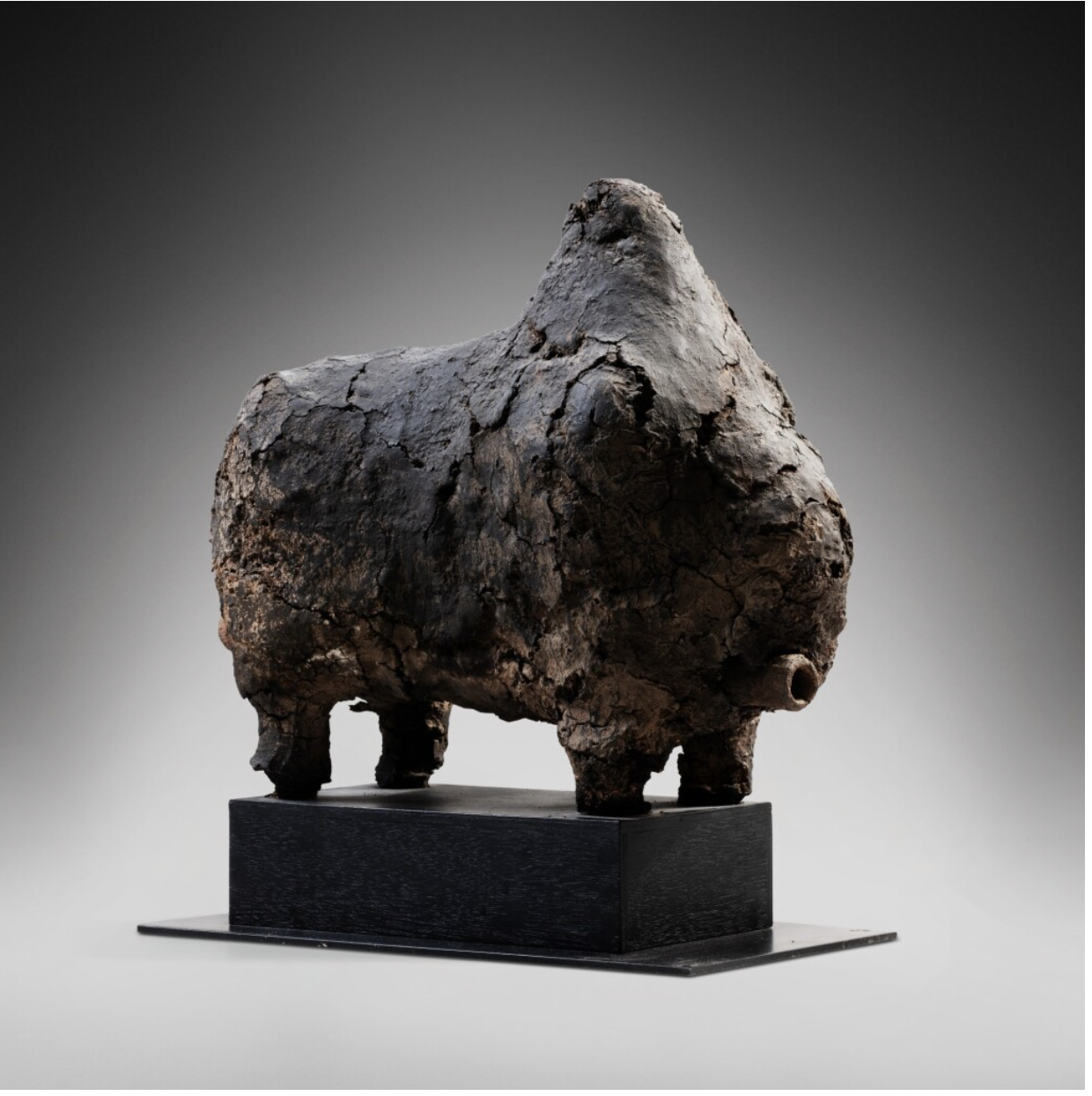
Bamana Boli figure, Mali
This question extended into the satellite works. Tie-stained papers were folded, dried, and unraveled into fragile body forms, their surfaces marked by stains that read as scars. These bodies carried the residue of process as evidence: violence not as spectacle, but as inscription. Nearby, collages assembled from ethnographic archives and fashion imagery collapsed distinctions between science and style, classification and desire. Bodies were fragmented, recomposed, made unstable refusing easy narratives of value or origin.
PRESS RELEASE
UNDER SKIN
Marcia Kure
12–20 December 2019
Royal Institute of Art, Stockholm
Mixed-media installation by United States-based Nigerian artist Marcia Kure opens on 12 December at the Royal Institute of Art in Stockholm: Under Skin presents a new chapter in the artist’s ongoing exploration through an investigation into identities and power structures across geography and community
Currently guest professor at the Royal Institute of Art in Stockholm, the artist opens a dialogue around ‘bio-power’, a term coined by French philosopher Michel Foucault in the 1970s, describing authoritarian rule over individuals and entire populations through optimised productivity. Systems of power achieve social subjugation through raised standards of living, welfare and health conditions as well as technological advances in a problematic trade-off for increased collective control. As such the concept of bio-power frames the social sphere and human life as governed by mechanisms that adjust the self as well as the collective for the purpose of control.
Under Skin takes the premise of bio-power, yet poses the question: Can community, in our day, create ideas and practices of power and with them, develop affirmative modes of living and socio-political organization? In contemplating this question, Kure’s starting point is the bull-shaped boli figure – the form and idea of which are central to the exhibition. Produced by Bamana sculptors from West Africa and owned by secret power associations, these enigmatic objects become potent tools for the manipulation of elemental and cosmic powers. Moreover, the accretion of diverse ritual materials, deposited over time by the owners on its surface or skin, invariably signified its accumulation of power and energy.
Kure’s boli figures, made from hair extensions, candle wax, plaster and pigments invoke the form of Bamana power figures yet gesture towards elements of high fashion, mass consumption and entertainment. Thus, though the figures seem playful, massed together, they constitute a coalition of diverse energies – pointing towards Hardt and Negri’s concept of multitude, arrayed against the global, post-ideological and post-national empire – as they stand strong together, on the checkered floor of the Royal Institute’s exhibition hall.
In a nod to Alexander McQueen’s 2005 runway show It’s Only a Game, in which fashion models at first move around freely, showing off the latest from the designer’s haute couture, but eventually are turned into marionette-like pawns on a chessboard lit up on the luminescent floor – until the game reaches a disastrous checkmate – Kure aligns the boli figures in formation, as if ready for a power play with Empire’s immanent forces.
The artist further explores the body as a site of protest in the satellite works that connect to the central stage occupied by the power figures. Here she implicates science as a tool that in the hands of political authorities is deployed to regulate human bodies, control knowledge, and maintain systemic order. What the spectator sees is tie-stained paper, which when dried and unraveled become bodies whose skins show scars of their physical trauma. These marked bodies bear testimony to technologies of bodily violence upon which old and new political hegemony depend.
Under Skin furthermore includes two of Kure’s new collages. Using material from the archives of the Ethnographical Museum in Stockholm, the artist reassembles body parts, objects from ethnographic auction catalogues, and images from fashion magazines to create figures in which the politics and histories of empire and colonial subjection, art and beauty, fashion and prejudice collide – thus suspending ready assumptions about meaning, value and valence of contemporary bio-power.
Marcia Kure studied at the University of Nigeria and is also an alumni of the Skowhegan School of Painting and Sculpture. In addition to exhibitions in Nigeria, Germany, the Netherlands, England and the United States, her work has been exhibited at La Triennale, Paris (2013), International Biennial of Contemporary Art, Seville (2006) and Sharjah International Biennale (2005). Kure is currently a visiting professor at The Royal Institute of Art where she works with the school’s students on the course Pushing Boundaries: New Forms of Sculptures, which seeks to broaden the definition of sculpture.
Royal Institute of Art Stockholm is a leading art institution for higher education and research in Stockholm with a long artistic tradition since the 18th century. It offers both graduate- and postgraduate education in art, and postgraduate education in architecture. The school runs an active international programme with projects, lectures, exhibitions and publications.
Rutiga Golvet (The Checkered Floor) was initiated in 2017 as a meeting space for art theory, publication, exhibitions and seminars, for artists to attend to urgent issues and to develop artistic and educational projects. Rutiga Golvet is a workshop space for thought and discourse where curators, editors, critics and art scholars are invited to interact with the Royal Institute of Art’s educational programmes – capturing, highlighting and deepening artistic and philosophical issues that exist at the school, and putting them in relation to a larger world.
Under Skin, curated by Sara Rossling.