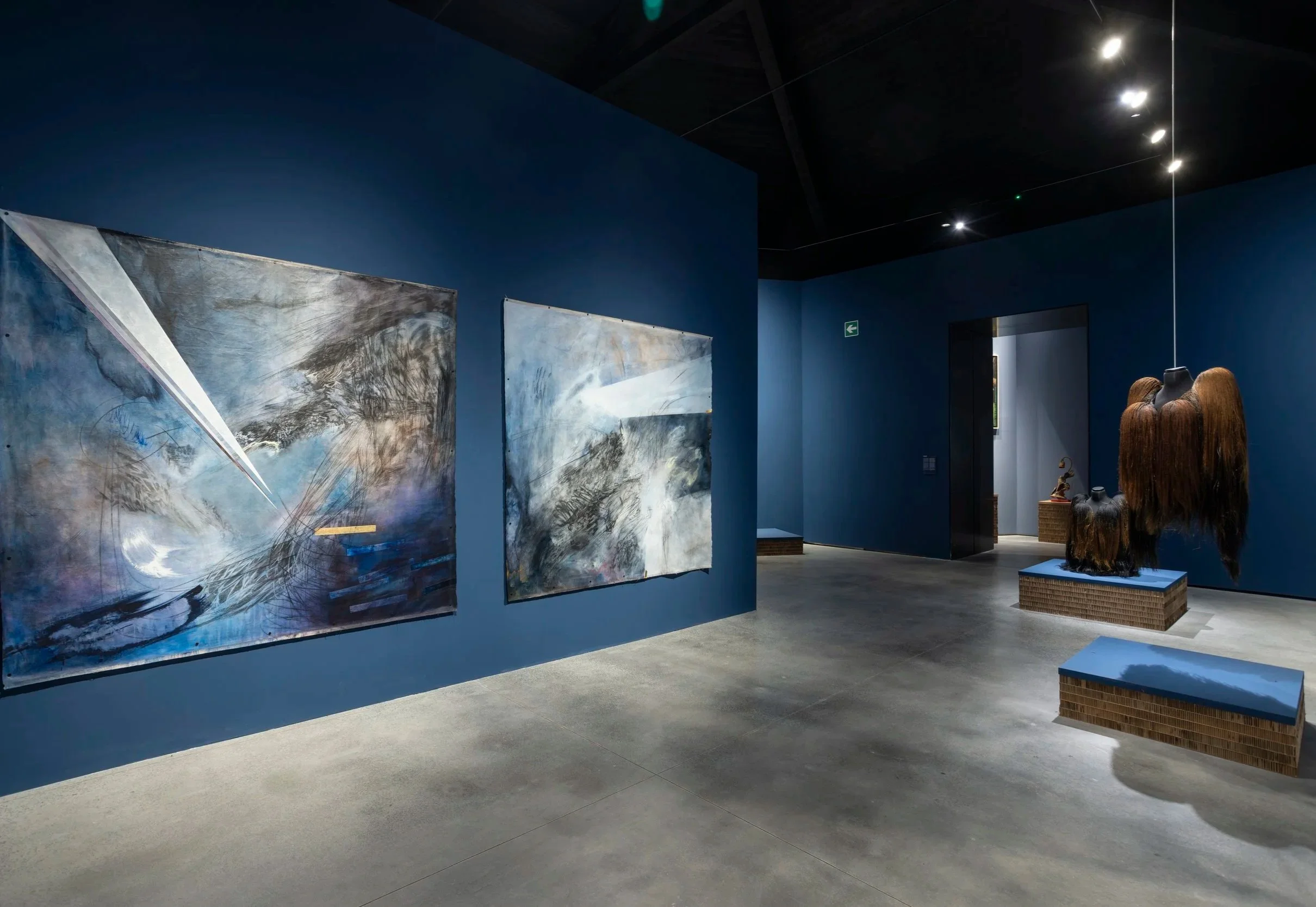
Installation View: Network V
"In refusing the spectacle of horror, the time has come to listen to the minor keys, to tune in sotto voce to the whispers, to the lower frequencies; to find the oases, the islands, where the dignity of all living beings is safeguarded."
— Koyo Kouoh
The light is low. Deliberately so. Set until the room becomes interior, subdued, suspended. The intention, to feel the room before you enter it. Move toward it, slow down, let your eyes adjust. The drawings reveal themselves under that kind of attention, fragile and aggressive at once, marks that only surface when you are close enough to feel the scale of them.
Two of the sculptures hang suspended. They sway. Not mechanically but from air movement, from the passage of bodies through the space. Your presence animates them. They rotate slowly, foreboding, like armor that breathes. The sound of the room reaches you before the work does, the low hum of conversation, footsteps entering and leaving, the particular quiet that settles when someone stops in front of something and stays. People stood close and asked how they were made. The answer is labor: hair braided by hand, each strand worked into form over hours. That labor is visible in the object.
I watched people move through the installation. They slowed. Some reached toward the work and stopped themselves. Some stood for a long time in front of a single drawing, leaning in, then stepping back. The room was alive in a way I had not anticipated, not from the work alone but from the encounter between the work and the bodies inside it, the sound of them, the weight of them, the way their movement made the sculptures turn. That was the network becoming visible.
Drawing is a minor key. It has always been. Not the grand gesture of painting, not the weight and presence of sculpture. The line. The trace. The mark that persists below the threshold of visibility. To tune in sotto voce, to follow the whisper of charcoal grazing across a surface, to stay with the evasiveness and instability of the drawn line, is to listen to the lower frequencies. To find stillness inside the web we are all entangled in.
The network does not begin or end. It is a continuous loop. No one stands outside it. To enter the installation is to become ensnared, another body caught in the web, in constant relation to the drawings and sculptures that surround you, another presence registered, another mark. Network V does not offer a position of observation. It places you inside its grasp.
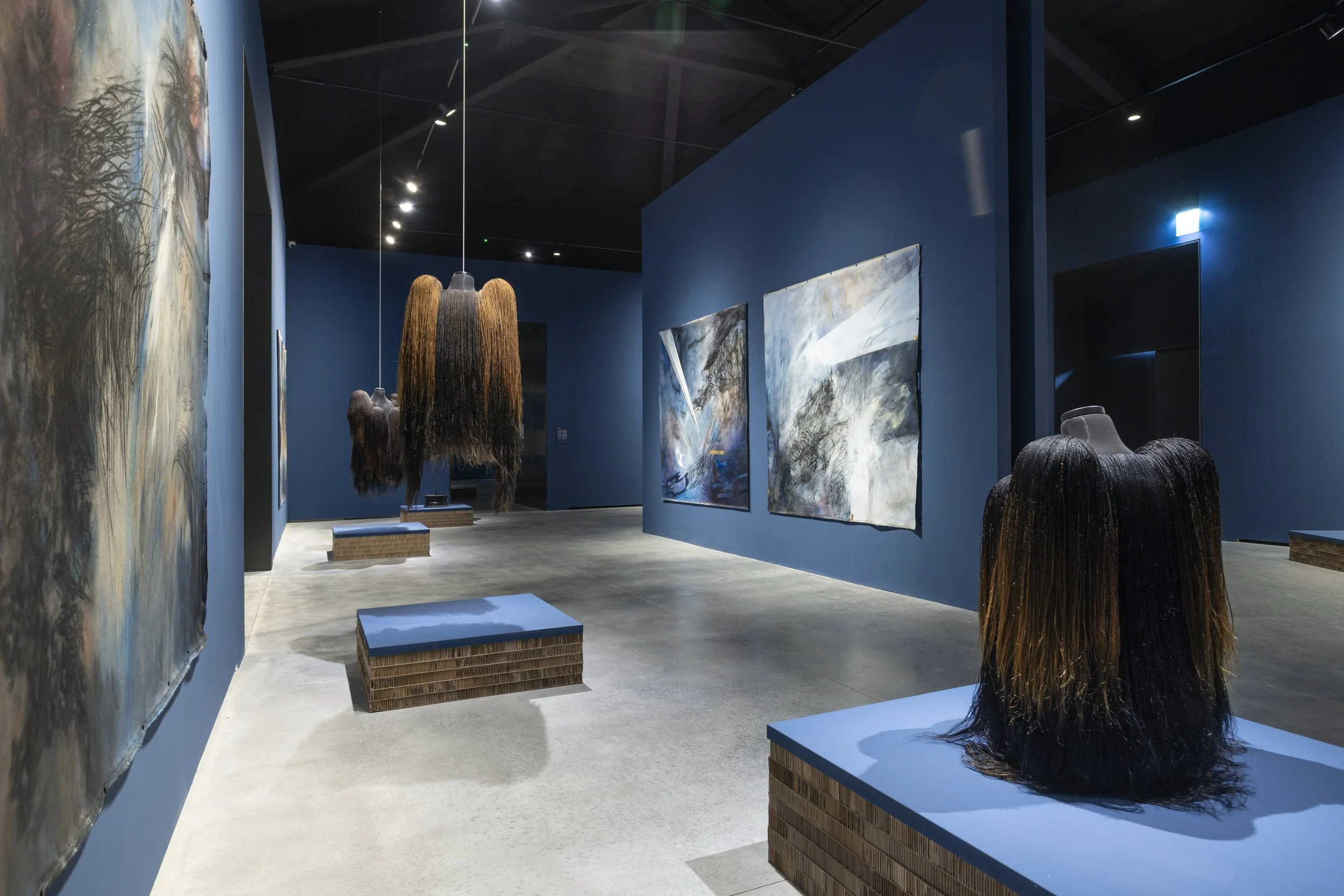
Installation View: Network V
A scar, a trade route, a tally mark, a cable line, a glyph. They collapse into one another.
I have always felt unease with fixed and firm definitions. That is probably why my work moves between Nigeria and the United States, between drawing and sculpture. Definitions are useful. You cannot address a problem until you define it. But they are also restrictive, keeping things in place that are already evolving, becoming another. My interest lies in where one definition is already slipping into another. The process of something becoming.
The body in my work is no different. It refuses fixed definition for the same reason. The skin is substrate, but substrate that shifts, absorbs, transforms, carries histories it did not choose and cannot fully shed. To move between inscription systems is to move the framework around drawing itself. Drawing does not only occur on a two-dimensional plane. It occurs in space. It can be made with a pallet jack, the contrail of a plane, a cable laid across an ocean floor. The mark is wherever a body moves through a system.
These bodies carry the imprint of displacement, extraction, and transformation. They are shaped by what touches them: language, ecology, labor, and systems of power. My lines track encounters, accumulated pressures, forms of ongoing negotiation. Always negotiation. Nothing is ever settled.
What the body carries visibly and invisibly, what it refuses to release.
The materials I work with carry their own histories into the work. Indigo, charcoal, gold, kola nut. Chosen for what they have moved through. On the canvas their interaction is constant, each surface a field of tensions: the deep blue-black weight of indigo pressing against the volatility of gold, charcoal residue settling into erasure, a shade of kola nut pigment bleeding its own particular brown into the ground. The surface is never stable. It shifts as the materials move against and through each other, building an atmosphere rather than an image. Not all of what accumulates there can be read. Some marks may be legible, some may not. That is intentional.
Indigo and kola nut are central to this work. Their shades carry the labor of colonial trade routes, networks of hospitality, exchange, and social relation, each arriving with its own particular weight and history, each shade sitting differently inside the same web. Charcoal speaks to combustion, clearing, residue, and renewal. Gold carries extraction, imperial plunder, systems of value, and like all of these materials it does not sit still in time. Its value shifts with wars, tariffs, energy routes, the circulation of bodies and goods across contested territories. The television was on. The price of gold that day was transcribed directly onto the surface. News of conflict in the Strait of Hormuz entered the drawing as the shippers arrived to take the work to Venice. The same information moving through the market, the news, the canvas, the shipping container. The mark on the surface and the mark on the world were the same mark.
These materials arrive in the work already charged, carrying residues of movement, migration, contact, and time. They activate the image rather than support it, holding within a single gesture fragments of the world long enough for meaning to perhaps surface, but surely to disperse again.
The work moves through materials, each arriving already shaped by the hands that cultivated, extracted, traded, and carried it. Nothing is neutral. Everything marked by the lives that passed through it.
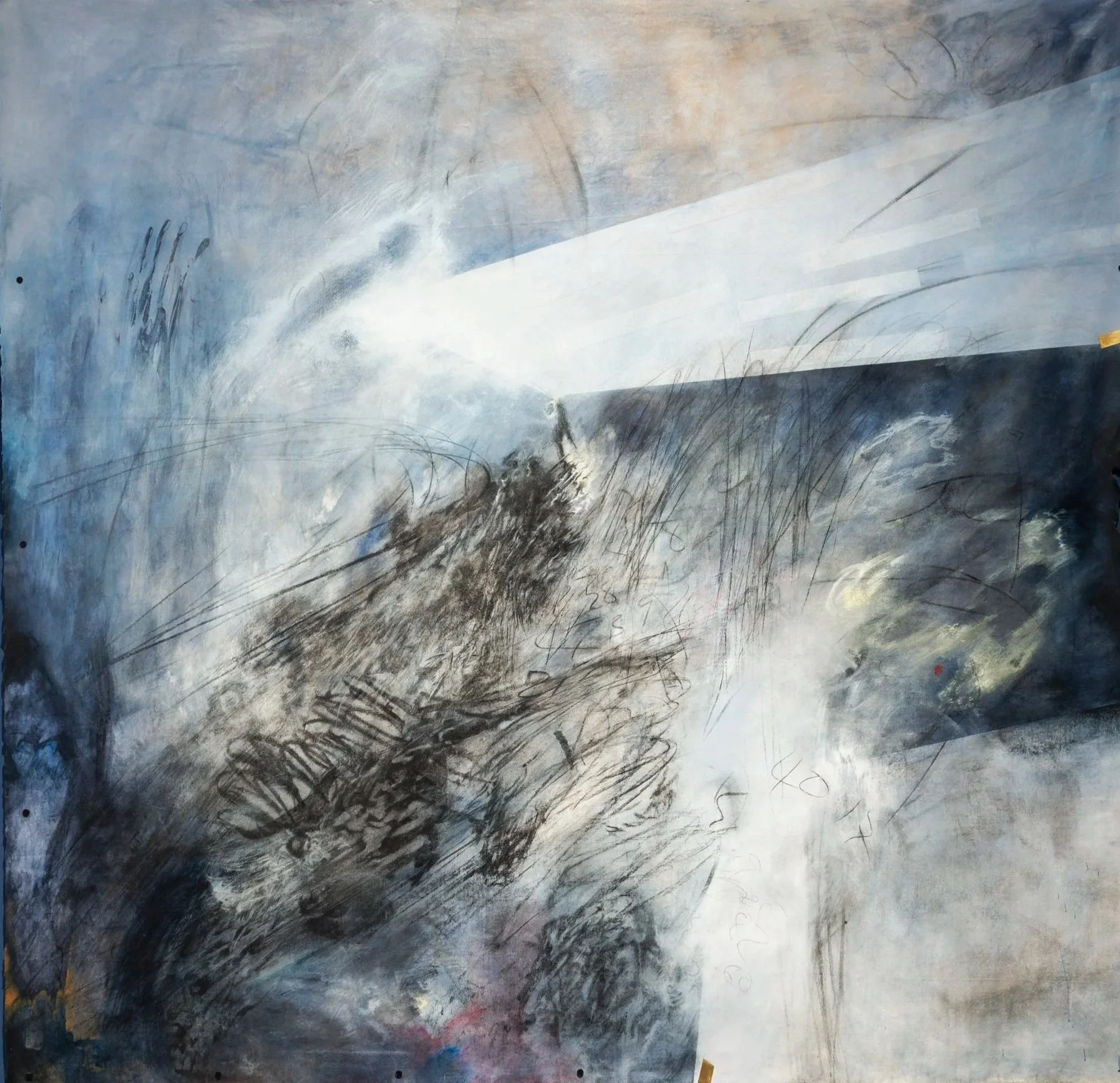
Network V:I
Nsibidi, Adinkra, Uli, Bamum, Ge'ez. A portion of a glyph is taken, combined with a code, transformed into a migratory route. The lines move between these systems and the marks of contemporary logistics: warehouse floor tape, pallet jack tracks, flight patterns, trade routes, cable lines. A trade route becomes a glyph. A scar and a cable line collapse into one another. The mark is never stable. This is the edge I keep returning to, between writing and drawing, between the pictograph and the flight path, where meaning is not fixed but accumulating, where one system of inscription translates into another without fully resolving into either.
To trade routes, shipping lanes, cables laid across ocean floors, trajectories drawn across the sky. The personal and the planetary held within the same mark.
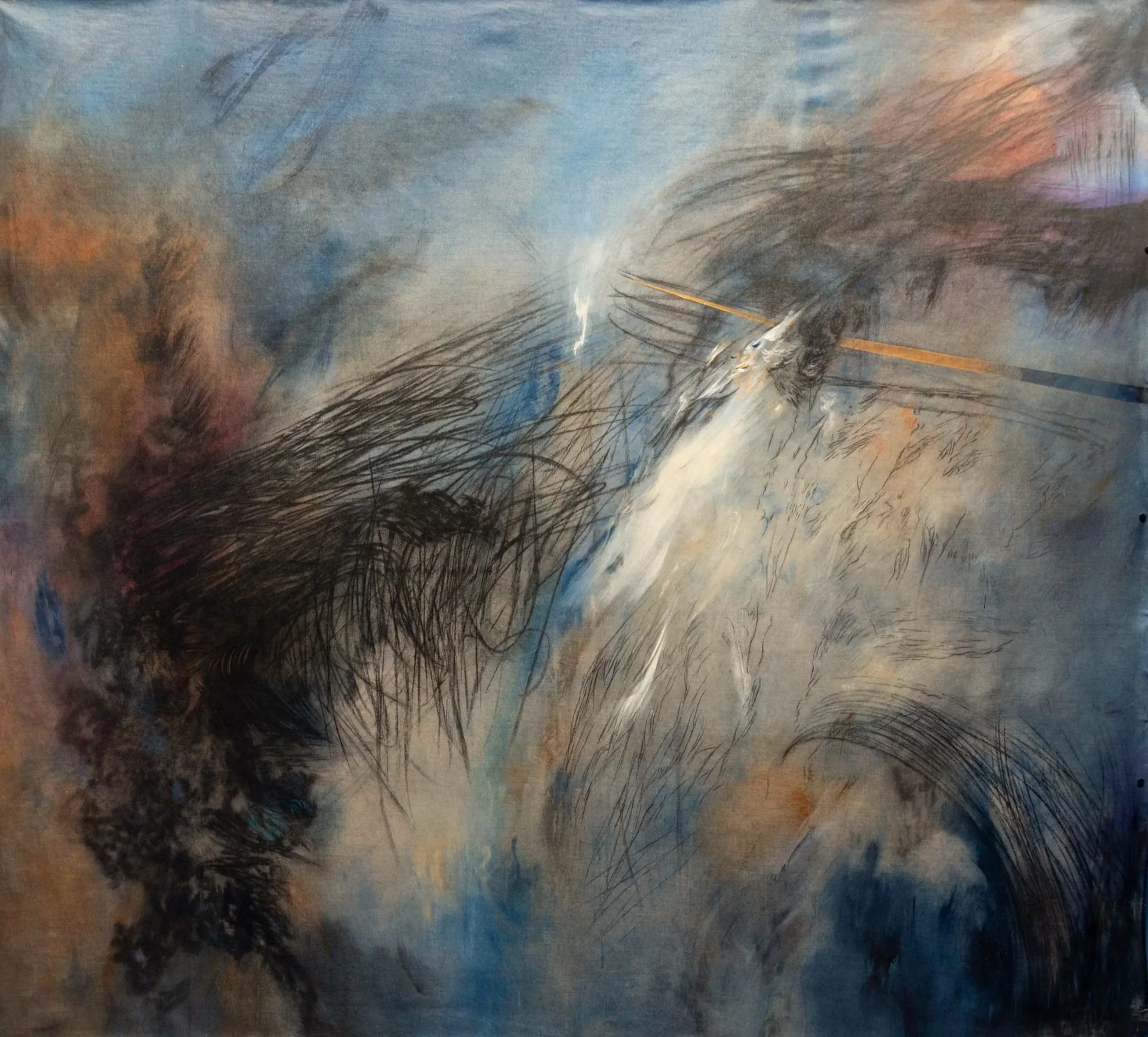
Network V:VI
The canvas surface is built through light glazes, marks layered over one another, unconventional materials used to score, break, and erase. The process is additive and subtractive at once, traces built upon, erased, built upon again. I know instinctively when a drawing is done. It is when I push it yet it refuses to accept any more marks, as if one more stroke would disrupt the current conversation and begin another one. When I have slightly exceeded its limits. When it starts to spill over. I stop.
This did not begin with Venice. It was already underway, shaped in part by my own experience working in logistics warehouses and fulfillment centers. Inside those spaces everything is tracked, timed, monitored, and optimized. Labor becomes logistical. Workers tethered to machines and screens, moving through immense systems of circulation. What struck me was the choreography: hazard tape directing bodies across the floor, marks left by pallet jacks, scanners translating movement into data, inscriptions on packages arriving from across the world. The warehouse floor was itself a scored surface. Routes organized bodies in motion. I began to understand contemporary logistics as a form of inscription operating at architectural and planetary scales, continuous with the trade routes, shipping lanes, and cable lines that run through the drawings. The warehouse and the drawing were the same thought.
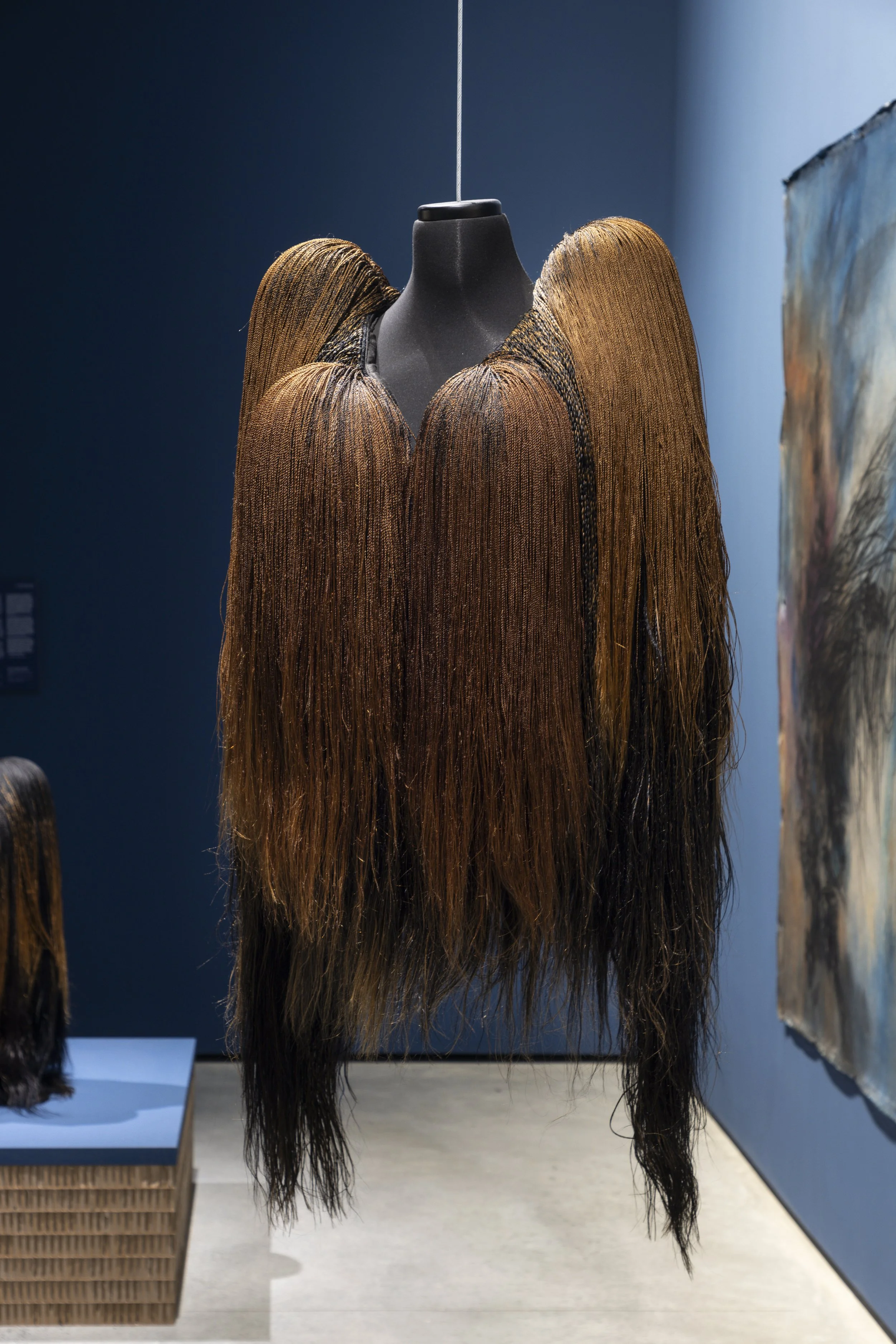
Network V: Roadkill II
The Roadkill sculptures came out of that same period. On my way to work I encountered animals suspended at the threshold after impact, caught between the living and the dead, between natural life and industrial infrastructure, between the sacred and the expendable. The sculptures hold that suspension. Composed of synthetic hair, they occupy a space between the organic and the manufactured, hybrid beings formed not in aftermath but in the moment of collision itself. I was moving through these systems, tethered and tracked, trying to understand my own position within global networks of labor, migration, exchange, and visibility. Having practiced in Africa, Europe, and America, there is something uncomfortable about being inside the system you are also trying to trace. I am not sure I have fully resolved it.
The work holds what cannot be fully read. Resistance living quietly inside what remains unseen.