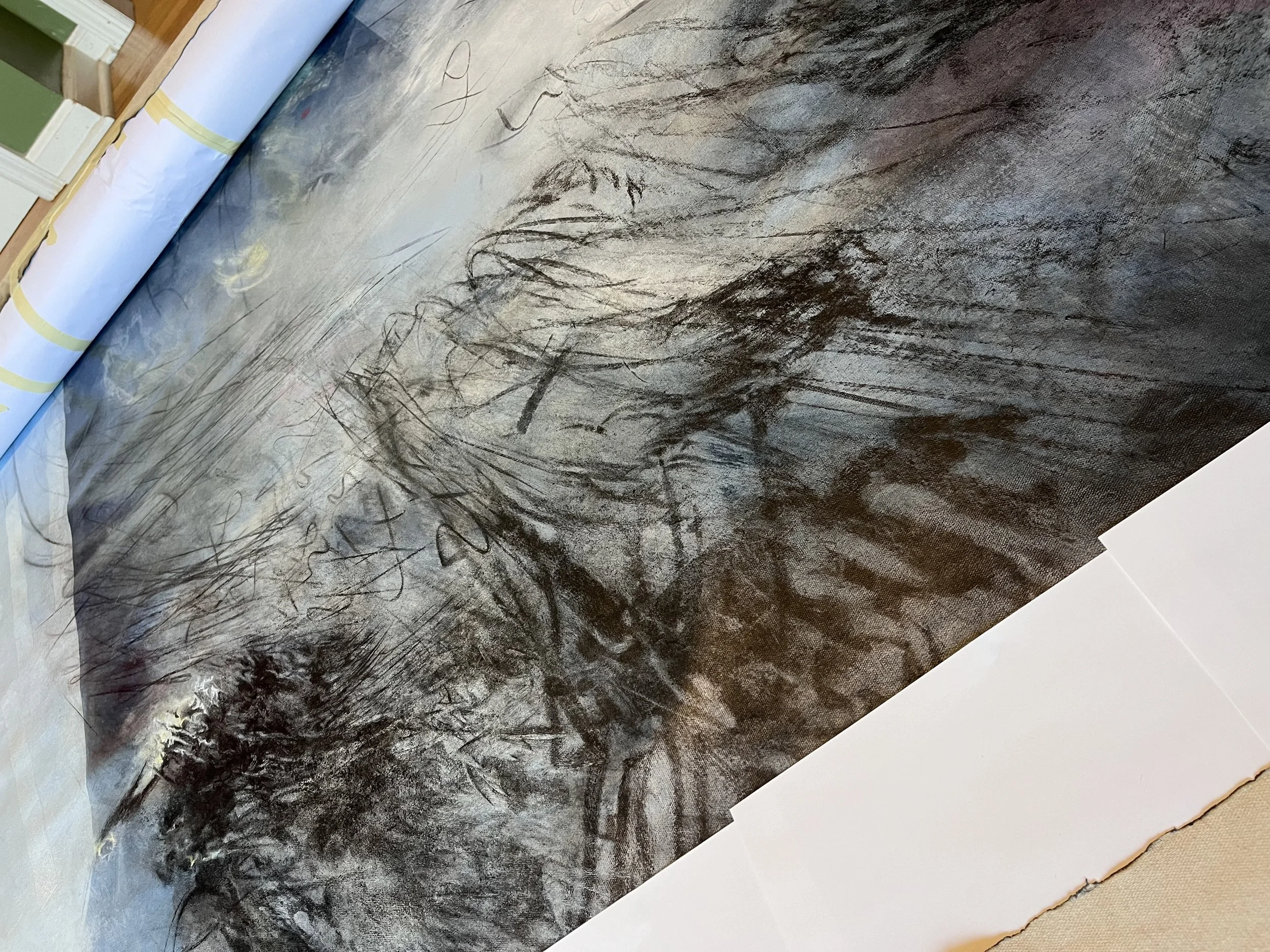
©Marcia Kure, Network V (Detail) 2026. Large-scale drawing from Network V with a richly layered surface built from charcoal, acrylic, graphite, and subtle traces of gold. Dense, intersecting lines spread across the composition, forming a network of routes, crossings, and clustered marks that suggest movement, circulation, and infrastructure. Areas of deep indigo saturation contrast with lighter, abraded passages, creating a sense of accumulation and erosion over time. The marks produce a dynamic field of connections, evoking glyphs, trade routes, data flows, and systems of exchange. The surface appears worked and reworked, holding traces of pressure, repetition, and material history.
Line as network, infrastructure, and inscription
After my return from Sweden, I began to reflect deeply on the experience and reassess the role of the line in my work. I demanded more from it, not just as a formal device but as a conceptual tool. I explored its many manifestations: line as form, couture, gesture, writing, drawing; line in space; line as infrastructure; and line as network. It became a way to articulate systems, bodies, and relations, both visible and invisible.
As I traced the movement of goods, my focus turned to the mechanisms of power that govern circulation: who controls it, who assigns value, who is allowed to cross borders, and who is not. The more I examined these flows, the more evident it became that capital organizes bodies, borders, land, and territory according to its own logic of accumulation.
I began to consider merchant capitalism not as a historical footnote but as a foundational structure. It was an early form of capital that generated profit not through production but through movement: buying cheaply in one place and selling at a premium in another. It operates through extraction, displacement, and removal. It renders land fungible and bodies exchangeable. Merchant capitalism laid the groundwork for contemporary systems of trade, surveillance, and logistical control. These structures continue to shape how we move through the world.
This led me to ask: under what conditions does something become a commodity? What must be displaced, enclosed, or coerced to make circulation possible? What forms of violence sustain the flow of goods? These questions sharpened my interest in the control of land and territory, not simply as geography but as infrastructure for profit. Borders are not just lines on a map; they are instruments of exclusion and inclusion, enforced through power.
In the studio, this inquiry brought renewed focus to the body as both subject and object of these systems, a site through which capital moves, but also one that resists, absorbs, and remembers.
I began to recognize the continuity between systems: how one structure leads into another, how seemingly distinct processes are deeply entangled. At the same time, I confronted the limits of perception. The vastness of these networks makes them impossible to grasp in their entirety. I could only ever see fragments: partial glimpses of an expansive, evolving mesh.