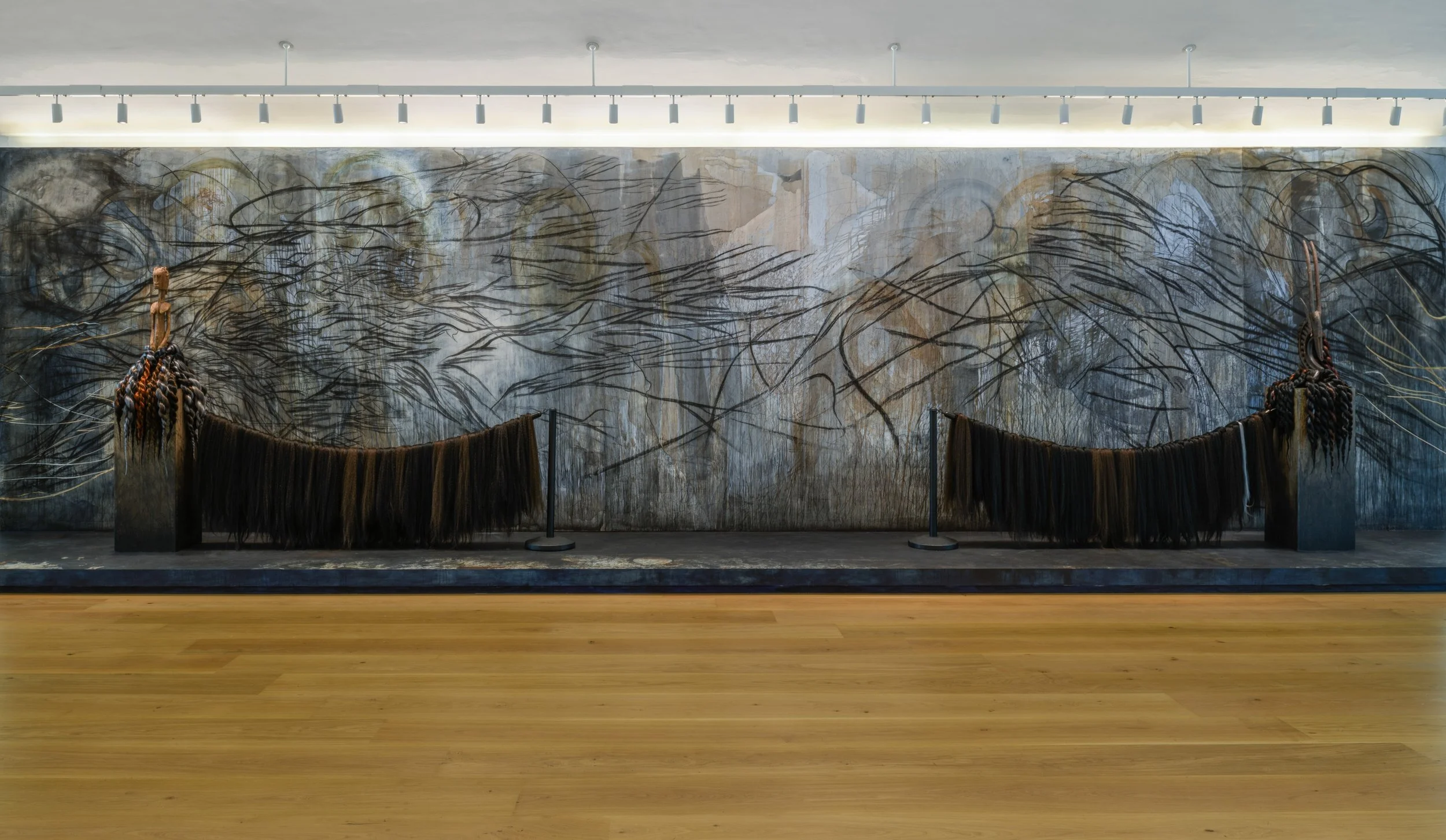
Marcia Kure, NETWORK 2021, Menil Drawing Institute, Houston, Texas © Photographs: Paul Hester
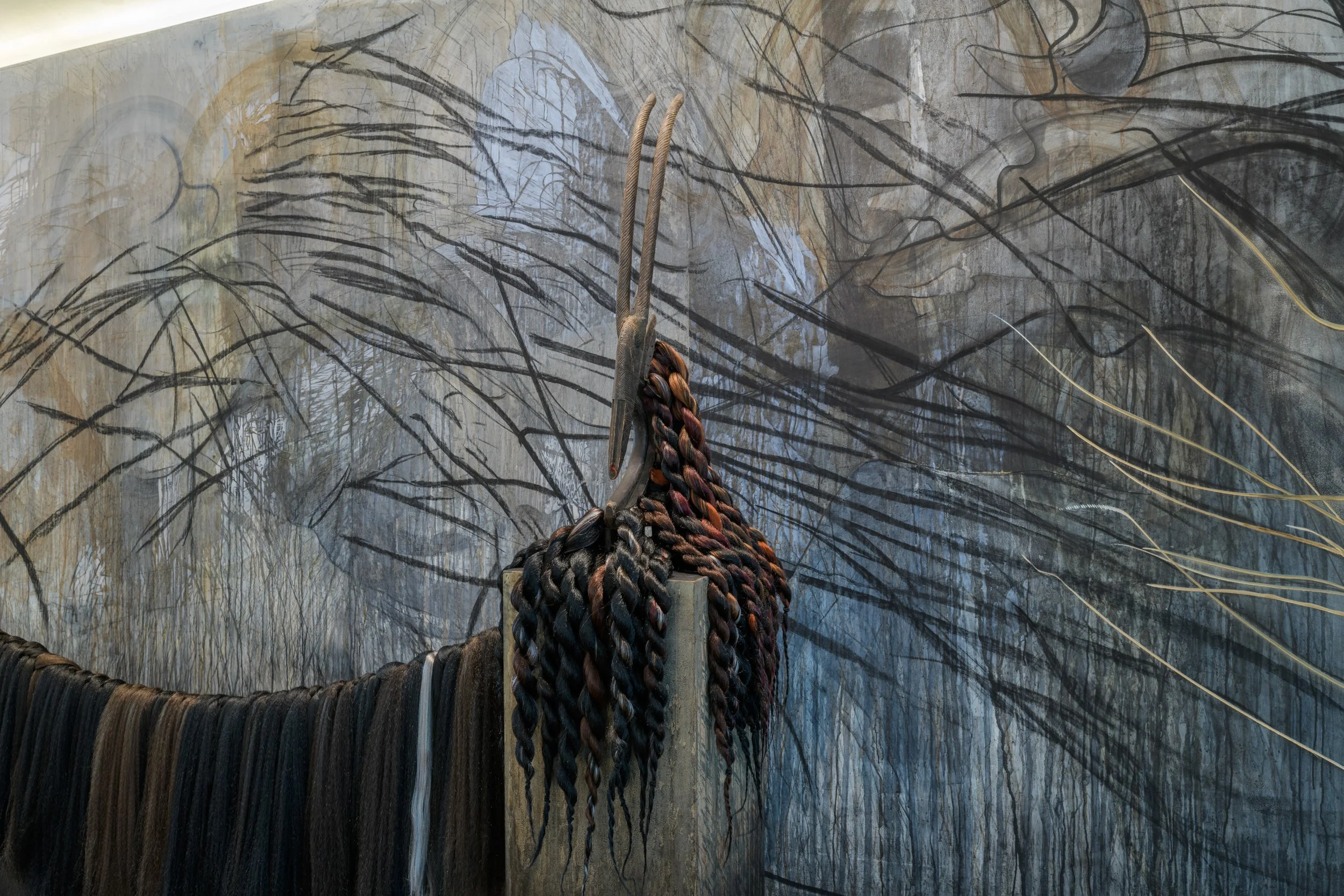
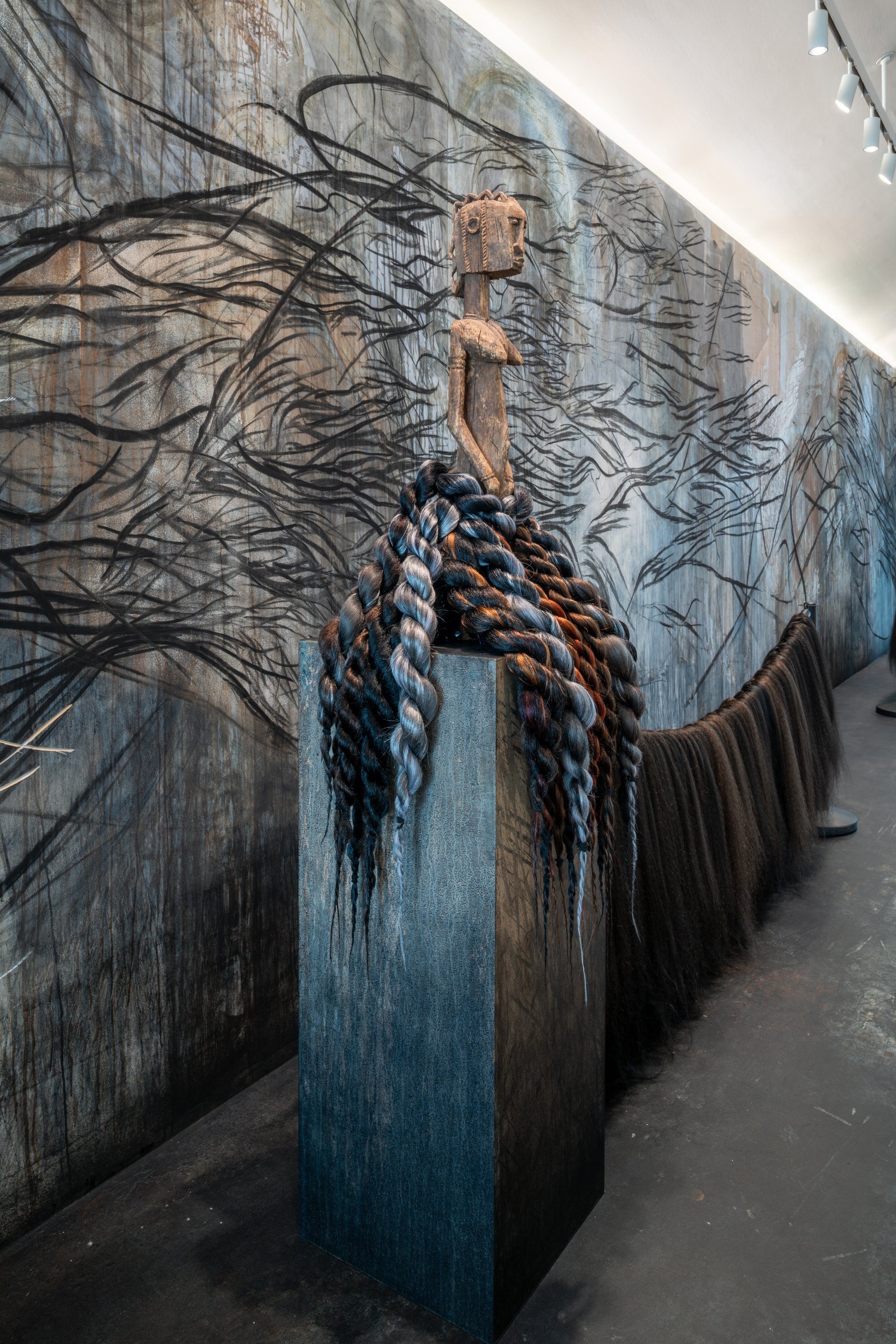
In 2021, I was commissioned to create a site-specific wall drawing for the Menil Drawing Institute in Houston. The installation spanned thirty-six feet across a threshold wall, unfolding through a layered field of materials: charcoal, indigo and kola nut pigments, tea, acrylic, biochar, digital print, synthetic hair, and two carved figures. It operated as a material, historical, and conceptual system whose full force required the viewer's movement through space.
The line in NETWORK is not contour but conduit, carrying histories, materials, and forces that precede the mark. Drawn with materials that were moved, traded, and extracted across imperial systems, each mark arrives weighted by histories anterior to the gesture itself. Indigo is not applied as symbol or metaphor; it arrives as archive: plant chemistry, forced cultivation, the reorganization of bodies and land in service of a color. The routes are already in the pigment. The mark inherits them.
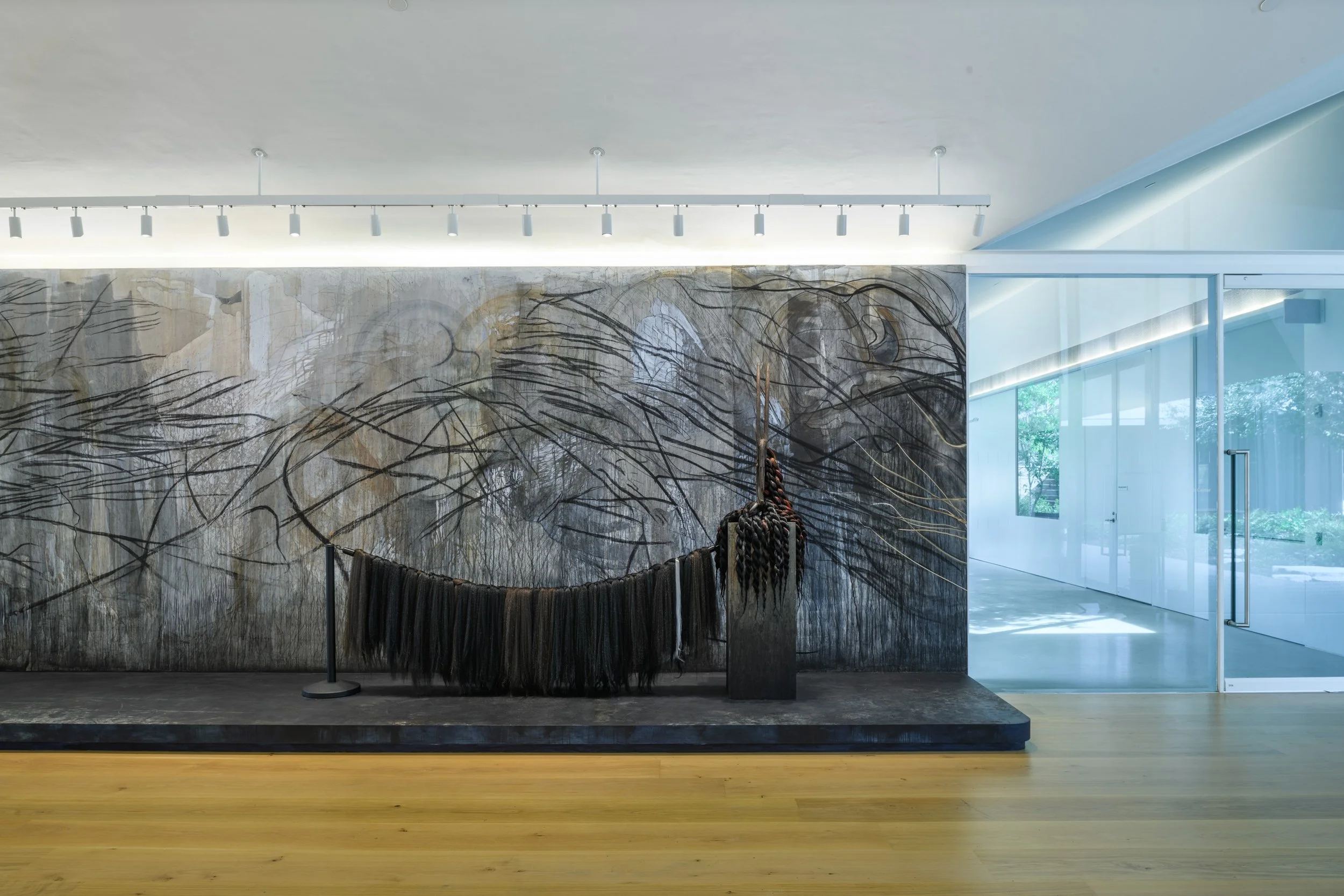
Materials were selected not for legibility but for their actual itineraries: kola nut as stimulant and sacred offering; tea as colonial cultivation compressed into leaf; synthetic hair as a mass-produced commodity embedded within Black diasporic beauty economies and protective practices. Each material performs its own labor, carries its own route, and coexists within the same field without resolving into the others, their proximity generating pressure rather than synthesis.
This system extends beyond the visual. The work resists apprehension from any fixed position; one moves along its edge, encountering fragments: pigment, braid, object, glimpsed in passing and only partially retained. It asks the viewer to walk, trace, and provisionally assemble. Its spatial condition is one of implication rather than disclosure. You do not simply stand before it; you enter it. The wall is not merely a surface but a seam, a threshold that converts viewing into passage. To move through the space is already to be inside the system.
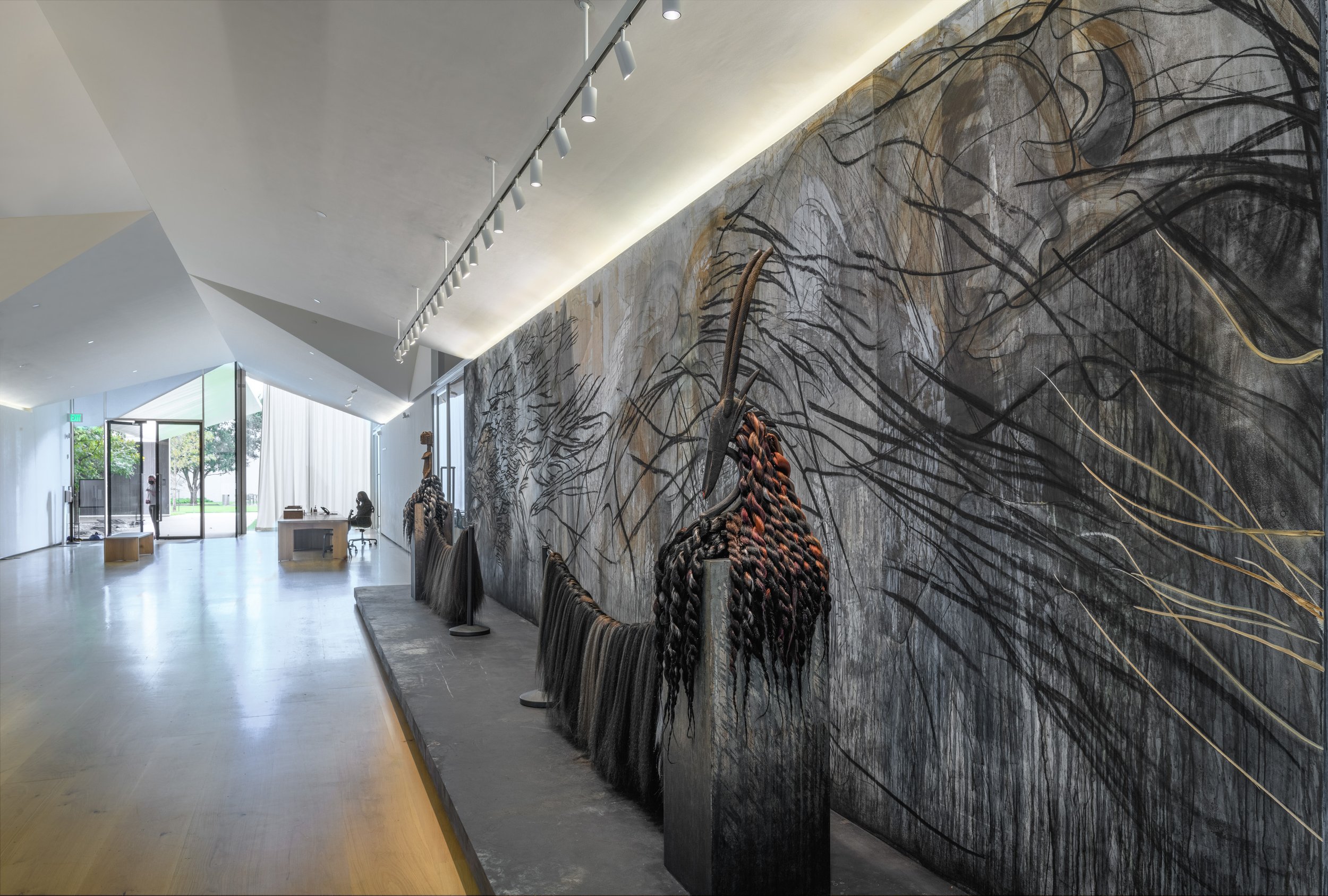
Pigment marks, hair stretches, wood bears. The viewer turns a corner, and the system shifts. Meaning is not deposited in advance; it emerges through encounter, through the viewer's passage across a field that is always only partially present to itself. There is no center from which this movement can be organized. The line does not begin or end; it branches, folds, disappears, and resumes elsewhere. Structure unfolds laterally. The sculptural figures extend this logic into space, forming provisional links across materials, time, and bodies. Some lines terminate; others diverge without conclusion. The wall holds these ruptures without reconciling them.
The two carved figures were purchased in markets and altered. Synthetic hair was braided into them as covering and binding, rendering each object estranged from itself and extending its circulation into new registers. These figures had already moved through economies of production, exchange, and handling before entering the installation. The alteration does not conclude that movement; it reanimates it, connecting the figures to the networked logic of the work and to the bodies of viewers who pass close enough to register the detail.
Gouge marks cut into the wall shift the work from surface to structure. They register pressure rather than depiction, marking sites where force has been applied, resisted, and absorbed. These incisions interrupt the continuity of the field, refusing the neutrality of the wall and exposing it as a material under stress. Drawing here is not only additive but subtractive, not only trace but incision. The gouge marks hold the memory of contact, where gesture becomes impact and surface becomes record.
The work draws on the visual grammar of cartography but does not resolve into a map. Lines suggest movement without fixed direction, connection without coordinates. Routes and flows are invoked only to be disrupted. What emerges is a fragmented cartography, partial and unstable, resistant to the totalizing view that mapping promises. It is what remains when mapping fails, when tracing becomes a record of rupture rather than an instrument of control. The work holds together through contact rather than order.
The viewer does not stand outside that contact. Movement activates the work: pausing, misreading, returning. Perception becomes participation, and participation is always partial, a fragment of a whole that cannot be fully held. What is missed on one pass may surface on another. To move through it is to read without arriving. The work does not conclude; it continues to move through those who have moved through it.